

What Is the Sales Engineer’s Real Product?
How sales engineers see what they deliver and how others see it
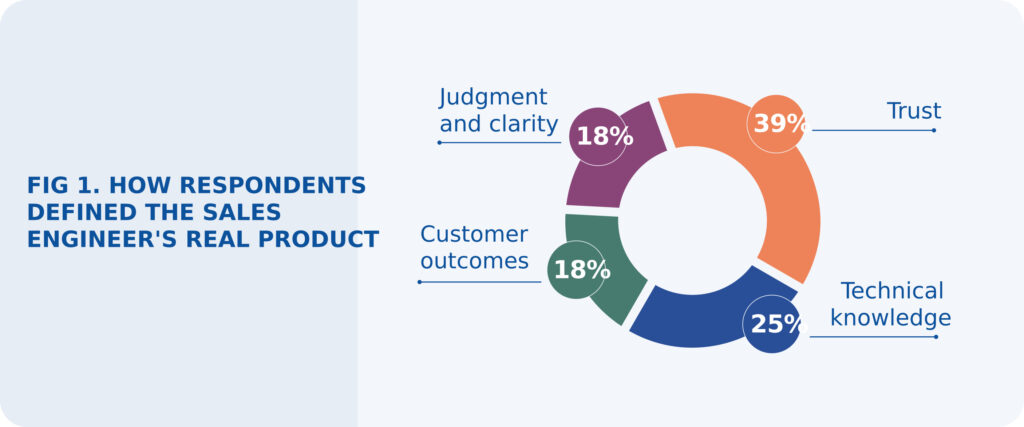
Among the 141 included respondents, Trust was the most common answer, selected by 39.0%. Technical knowledge followed at 24.8%, while Customer outcomes (18.4%) and Judgment and clarity (17.7%) were nearly even. No option received a majority, but Trust led the next-highest answer by more than 14 percentage points.
Discussion
The overall spread suggests that respondents were identifying different layers of the same contribution: what an SE knows, how that knowledge is applied, the confidence it creates, and the outcomes it supports. The poll therefore says less about which sales engineer skills matter than about where respondents locate the role’s value. The next comparison shows that people inside and outside the role emphasize different points in that process.
“It is not always about how well you know the clickable aspect of the product or technology, but how it fits in with the wider ecosystem to solve the customer’s problems…”
Trust led inside the SE role. Technical knowledge led outside it
The strongest divide was between how current SEs defined the role’s value and how other professionals defined it. Among 52 current SEs, 55.8% chose Trust and only 5.8% chose Technical knowledge. Among 70 professionals outside the role, Technical knowledge was the most common answer at 40.0%, while 27.1% chose Trust.
The outside group included 22 people in sales, account management, or business development; 12 in technical, product, or IT roles; 31 in other business functions; and 5 who were retired or did not fit the other role groups. Nearly half were therefore in commercial or technical roles that typically work alongside SEs or participate in technical buying decisions, although direct interaction with SEs was not verified. Former SEs and two respondents whose SE history was unclear were excluded from this comparison.
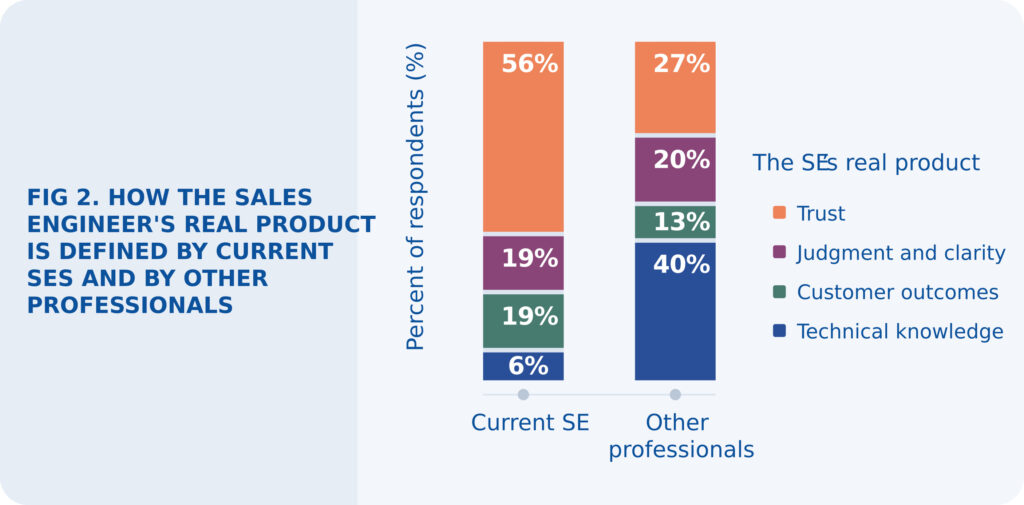
The difference across all four answers was statistically significant (p < 0.001) and remained significant after accounting for geography, industry, and total time in the workforce (p = 0.037). The clearest adjusted result concerned Technical knowledge: current SEs had approximately 80% lower odds of selecting it than other professionals (adjusted OR = 0.19; 95% CI: 0.05–0.78).
Discussion
The gap is best understood as a difference in where each group locates value, not as disagreement over whether technical expertise matters. From outside, Technical knowledge is the most visible contribution. Inside the sales engineer role, that expertise may feel like an assumed foundation rather than the final deliverable. SEs may therefore be more likely to name what it enables: Trust in the person, the recommendation, and the decision.
Trust develops when technical depth is combined with curiosity, business context, and judgment about the customer’s problem, then applied to help a buyer understand tradeoffs, reduce uncertainty, and move toward a decision.
That difference can shape how the function is used. An organization that sees the SE primarily as a source of Technical knowledge may bring the role in late and on demand, measure technical activity, and respond to capacity problems by adding more technical headcount. A broader view can lead to different choices about deployment, coaching, evaluation, and budget.
“What truly sets an SE apart is the ability to balance technical depth with business acumen. That balance is what makes them trusted advisors, not the technical knowledge alone.”
“The two beliefs lead to opposite staffing and deployment choices, which is why SEs so often feel misused by organizations that are not doing anything obviously wrong.”
“If you think in terms of a workflow, a workflow has inputs, actions, and outputs… Technical knowledge is the ability to execute the workflow. This leaves ‘output’ as the product of the workflow.”
“The colleagues and buyers around SEs are valuing something different from what SEs believe they’re selling. That’s a gap with consequences for how SEs position themselves, how leaders coach, and how the role gets defended in a budget conversation.”
Software and IT SEs placed more emphasis on Trust
To separate industry from role, we restricted this analysis to the 52 current SEs. We compared 35 working in Software or IT with 17 working across several other industries. Geography and total time in the workforce were nearly identical across the two groups, reducing concern that either factor explained the difference.
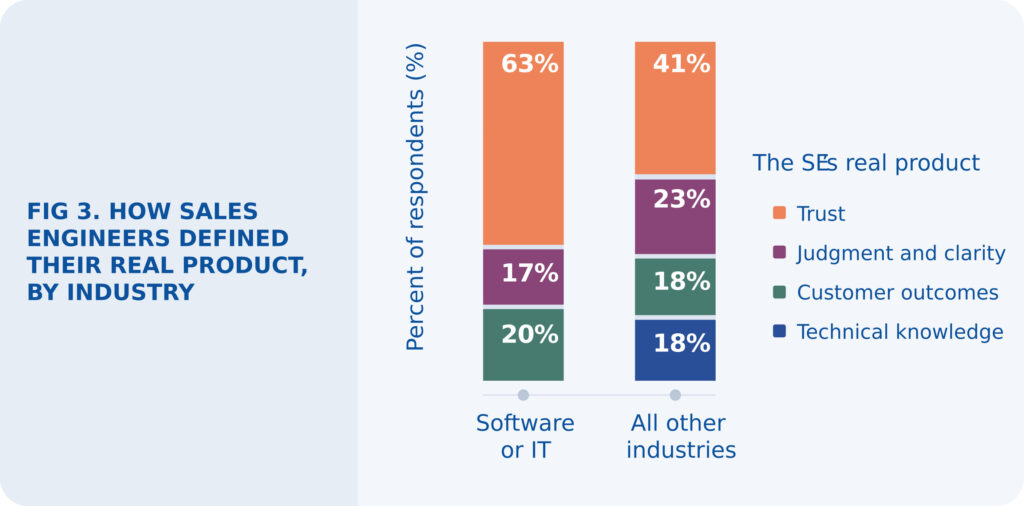
Among Software or IT SEs, 62.9% chose Trust, and none of the 35 chose Technical knowledge. Among SEs in other industries, Trust led at 41.2%, while 3 of 17 (17.6%) chose Technical knowledge. The full four-option difference was suggestive rather than conclusive (exact p ≈ 0.07), but the Technical knowledge contrast was statistically significant in this sample (Fisher’s exact p = 0.031). Industry context may therefore influence whether technical expertise is seen as the product itself or as the foundation for building trust. Because the non-IT group was small, this finding should be treated as exploratory.
Discussion
Within Software/IT, technical competence may be expected rather than distinctive. Product information is widely available, buyers often include their own technical evaluators, and multiple offerings may address similar use cases. The SE’s value can therefore shift toward reducing uncertainty around implementation, adoption, and the relationship that follows the sale. Trust does not replace Technical knowledge; it is partly built through the ability to make complexity understandable and give buyers confidence in both the recommendation and the vendor.
In industrial settings, Technical knowledge may remain a more visible deliverable. Physical constraints, engineering specifications, compatibility, safety, downtime, and capital risk can make the SE’s expertise central to whether a proposed solution is feasible at all. That makes the observed contrast plausible, but not universal. The pooled comparison group combines several industries with different products, sales motions, and role boundaries, and contains only a small number of respondents.
“Technical knowledge in software has become commoditized through readily available information online and through AI tools. SEs have shifted to locate their value elsewhere.”
“These partnerships build credibility based on the trust that is created by making complex issues seem simple due to the SE’s technical competencies.”
“In traditional industrial sectors, technical knowledge is not just a background requirement; it is a tangible work product.”
SEs with less total time in the workforce were more likely to choose Judgment and clarity
Among current SEs, Judgment and clarity was selected by 7 of 22 respondents (31.8%) with 0–15 years of total time in the workforce, 3 of 17 (17.6%) with 16–26 years, and 0 of 13 (0.0%) with 27+ years.
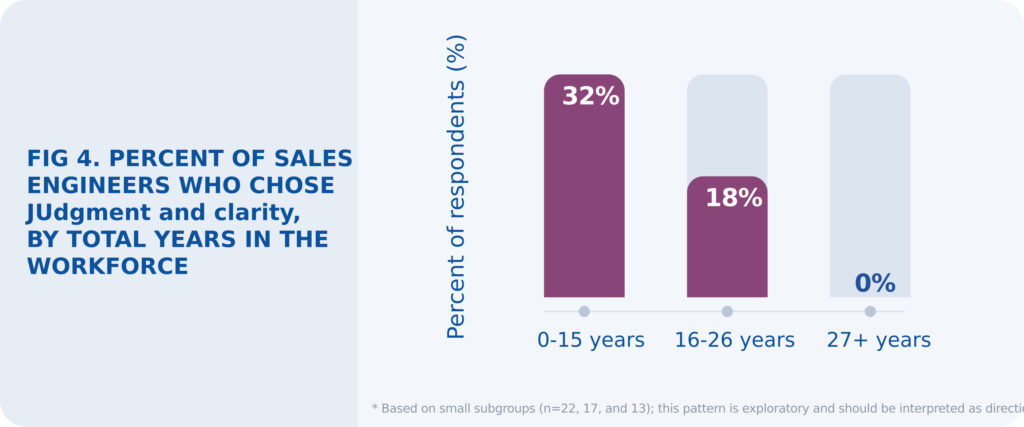
The same downward pattern appeared in an exploratory model accounting for Software or IT employment and geography. However, the overall voting distribution did not differ significantly by total time in the workforce, and no other option showed a statistically meaningful pattern. Given the small groups and multiple comparisons, this finding should be treated as exploratory.
Discussion
One plausible explanation is that judgment becomes less visible to the person exercising it. Decisions about what to include, omit, challenge, or clarify may begin as conscious work and later become automatic. An experienced SE may then name the accumulated result, such as Trust, rather than the mechanism that produced it. People with different career histories may also use different language for similar behavior; “Judgment and clarity” is newer community vocabulary than “trusted advisor.”
The chart cannot distinguish those explanations from several others. The 0–15-year band combines people at very different career stages; total time in the workforce does not measure SE tenure directly, and people still working as individual-contributor SEs after 27+ years may be an unusually selected group. With small subgroups and multiple comparisons, this is a direction worth testing with more targeted data, not a demonstrated progression.
“The two groups may not disagree at all. Newer SEs are naming the mechanism and veterans are naming the result.”
“The experience range of 0–15 years is too broad to make an inference. 15 years is a lot of experience. 1 or 2 isn’t.”
“I think judgment does go tacit with experience. But I don’t think this data shows it… The hypothesis deserves a better instrument, not a retraction.”
Concluding Words
Taken together, the findings point to a practical challenge for both SEs and their leaders. Technical expertise remains essential, but its value is not always understood in the same way by the people doing the work and those around them. SEs should make the trust, judgment, clarity, and decision support created through their technical work more explicit in customer conversations and internally. Leaders should reflect that broader contribution in how they deploy, coach, and evaluate the function. The poll does not fully answer what makes a good sales engineer, but it shows why the answer cannot be reduced to technical knowledge alone.
Methods
We received 144 responses to a LinkedIn poll asking, “What is the Sales Engineer’s real product?” The poll was shared on NAASE’s LinkedIn account as well as the account of NAASE’s community manager. Respondents therefore came primarily from audiences already connected to or interested in Sales Engineering, rather than from the general LinkedIn population. An organization account and two people directly involved in creating or analyzing the poll were excluded, leaving 141 respondents. Public LinkedIn profile information was used to classify current role, SE history, country, employer industry, and approximate total time in the workforce. The primary role comparison contrasted 52 current SEs with 70 respondents whose profiles did not indicate current or prior SE experience. Former SEs (n = 17) and respondents whose SE history was unclear (n = 2) were excluded from that comparison. Industry and experience analyses were restricted to the 52 current SEs.
For the primary adjusted analysis, geography was grouped as North America versus elsewhere, industry as Software or IT versus other industries, and total time in the workforce as 0–15 versus 16+ years. Multinomial logistic regression was used to test the association between current SE status and the four-option vote distribution. A separate binary logistic regression estimated the Technical knowledge contrast between current SEs and professionals outside the role, adjusting for geography, industry, and total time in the workforce. Among current SEs, another binary logistic regression tested the exploratory association between the ordered workforce groups and the Judgment and clarity response, adjusting for Software or IT employment and geography. For the latter analysis, total time in the workforce was grouped as 0–15, 16–26, and 27+ years.
Group differences were assessed using chi-square, exact, and permutation tests as appropriate. Small subgroup and exploratory findings were interpreted cautiously. Participation was self-selected and should not be treated as a representative population survey.
The full anonymized dataset is available upon request.
Contributors

Vice President of Business Development, Victus Defense

Global Solutions Leader, ShipBob

Vice President, Sales Engineering & GTM (Independent), Presales Navigation System

Founder and Principal, The Second Derivative

Co-Founder & Head of Consulting Strategy and Coaching Services, Miley Performace Group

Vice President of Revenue Operations, LootzySoft

Enterprise Specialist, Smart Trailers, Samsara

Mentoring, Training and Consulting, Tribu Ventas

Coach and Trainer on Presales Human Skills, Mustang Positive Professional Development