What SEs Can Steal from the Wolf of Wall Street (Without Becoming Him)

I know how this sounds. Jordan Belfort ran a sales floor on scripts, pressure, and penny stocks. What could he possibly teach a Sales Engineer, whose entire job depends on trust? If I pushed a prospect the way Stratton Oakmont pushed stocks, I’d lose the deal before the Zoom call ended. I’d also lose the relationship and any shot at a second meeting.
But strip away the boiler room and one idea survives the wreckage: people don’t buy when their objections are answered. They buy when they’re certain. That’s not to say objections don’t need answering. There are real logistical and technical requirements that must be addressed. But answering a direct challenge mid-demo is only half of objection handling. B2B stakeholders are no different from any other buyer. They need certainty in three places: the product, the person selling it, and the company behind it. Belfort’s “looping” technique was a system for rebuilding that certainty every time an objection knocked it down.
And here’s the uncomfortable part: many SEs (myself included) do the exact opposite. A prospect hits us with a pointed “wait — so we don’t get access to the codebase?” and we rush to neutralize it. “Well, there’s another product for that. This one is for speed.” Objection answered. Demo resumed. Certainty? Never rebuilt. You simply can’t answer an objection and immediately jump to your next screen or slide.
Answering an Objection Is Not Always the Same as Handling It
The following account is a lightly fictionalized composite: dialogue is reconstructed, and identifying details have been changed.
Here is how an SE can lose a demo the hard way.
The prospect was a regional hospital network. Their marketing team needed to launch nearly twenty sites and landing pages, fast. Service lines, clinic locations, recruitment campaigns. The product being demoed was a managed SaaS CMS with a curated set of modules. Its main value proposition is speed: sites that launch in days, with hosting, security patching, and module updates all managed for you.
The demo was going well. The whole web team was on the call, cameras on, chat busy. Then the network’s lead developer unmuted: “Hold on. You’re telling me if we use this CMS, we don’t have full control of the codebase?” For a moment, nobody spoke. The chat went still.
The SE had a good answer. It took about eight seconds: “If you need full control of the codebase, that’s what our PaaS solution is for. On this one, we manage it for you so you can spin up sites more quickly.” Technically true. Factually accurate. And they moved straight back into the demo flow, feeling pretty good about the quick save.
The team passed on the product. In the debrief, the AE relayed the developer’s feedback: the SaaS CMS “felt like it would be limiting.” The exact concern the SE had answered. Answered — but not handled.
Here’s what was missed: an objection is almost never just a question about the product. It’s a drop in certainty. When that developer pushed back, here’s what they were really saying: I’m now less sure this product fits us. Less sure you understand our environment. Less sure your company builds things the way we’d build them. The eight-second answer addressed the surface question and left all three doubts fully intact.
What Looping Actually Is (And What It Isn’t)
Belfort’s Straight Line system treats every objection as a smokescreen. The real problem is uncertainty in one of three areas: the product, the salesperson, or the company. He scores each, from least certain to most certain, on a scale of one to ten and calls them the “three tens.” When an objection comes up, you don’t just answer it — you loop. That means addressing the concern, then deliberately rebuilding certainty in all three areas before you move forward again.
In his world, that meant scripted rebuttals and relentless closing pressure. But we can leave the bad and run with the good. We’re not closing anyone on the demo call, and SEs who create pressure destroy the very trust that makes us effective.
But the diagnostic is gold, because it reframes objection handling entirely. When a technical objection lands, ask yourself: which certainty just dropped?
“So it doesn’t integrate with X?” is usually a product certainty problem. “Have you worked with hospital networks like ours?” is a company certainty problem. And the pointed “we don’t get control of the codebase?” often signals doubt in all three areas at once: the product’s design, your grasp of their world, and your company’s fit for customers like them.
Once you see objections as certainty drops instead of quiz questions, the way you respond changes.
The SE Loop: A Two-Move Warm-Up, Then the Loop
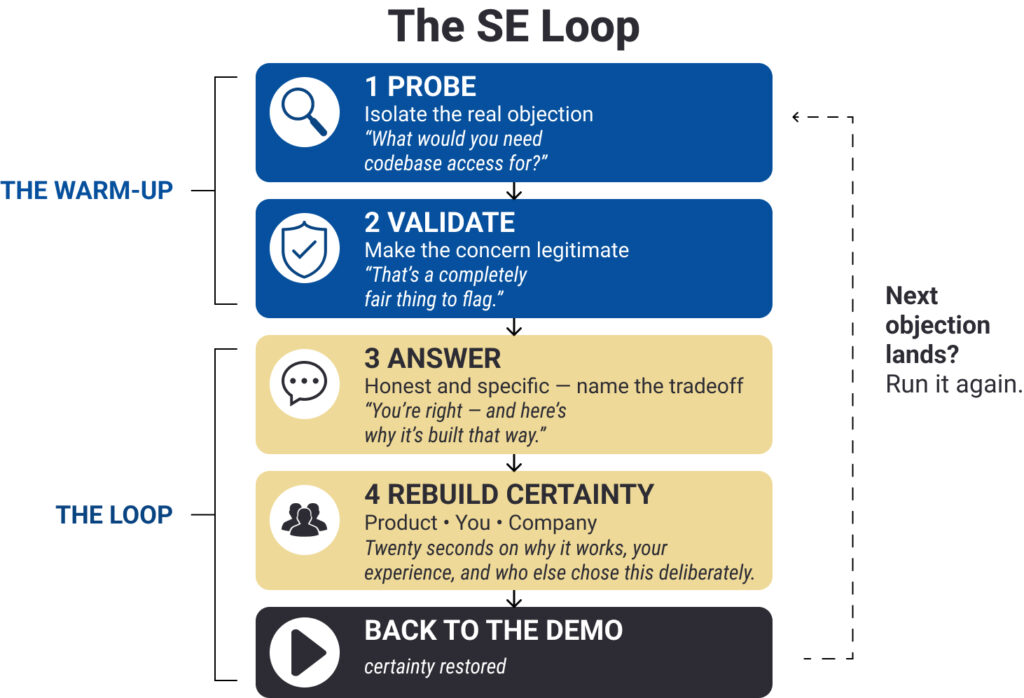
The first two moves are a consultative warm-up I added to Belfort’s loop. An SE needs to understand the objection before rebuilding certainty around it.
The warm-up:
1. Probe before you answer. Don’t respond to the objection you heard. Respond to the one they have. Ask one probing question first: “What would your team need codebase access for?” Or use Chris Voss’s labeling technique, described in Never Split the Difference: “It sounds like you’re worried you’d be locked out of customizing these sites down the road.” Then wait for the correction or elaboration. Either one reveals the real objection.
2. Validate the concern. Explicitly. “Yeah, if your team is used to owning every line of code, that’s a completely fair thing to flag.” Validation doesn’t concede the point; it tells the prospect their pushback made the conversation better.
Now the loop itself:
3. Answer it honestly and specifically. Give your answer, anchored to what you learned in the warm-up. If there’s a real tradeoff, name it. “You’re right — you don’t get direct access to the codebase on this product. Here’s why it’s built that way.” An honest tradeoff builds more certainty than a perfect-sounding dodge. Technical buyers can smell a dodge from three time zones away.
4. Rebuild certainty, then return to the demo. This is the heart of the loop, and the part almost every SE skips. Before you jump back into your flow, spend twenty seconds rebuilding what the objection knocked down. Certainty in the product: why it works this way and the outcome it enables. Certainty in you: your firsthand experience with exactly this situation. Certainty in the company: proof that similar customers chose this approach deliberately. Then resume the demo. Loop closed.
The whole sequence takes sixty to ninety seconds. It feels slow in the moment. It’s dramatically faster than a stalled deal.
What the Loop Sounds Like in a Real Demo
Here is how the same objection could have been handled using the warm-up and the loop.
Lead developer: “Hold on. You’re telling me if we use this CMS, we don’t have full control of the codebase?”
The warm-up — probe: “Fair question — help me understand your setup. When your team launches a new site today, who’s touching the code, and what are they changing?”
Developer: “Everything is custom. Our two developers build each site from our base theme. Honestly, it’s why a new landing page takes us three months.”
The warm-up — validate: “Got it — so full control is how you’ve always guaranteed quality. Coming from that, handing off the codebase would absolutely feel like a red flag. That’s fair.”
The loop — answer: “Here’s the honest tradeoff: you’re right, you don’t get direct codebase access on this product. That’s a deliberate design choice. The platform manages it all: the core codebase, the module set, the security patches. That’s what makes launching site number twenty as fast as launching site number one. And your team keeps full control of everything editorial: themes within the design system, content models, layouts, integrations.”
The loop — rebuild certainty: “Your three-month problem is exactly why marketing teams at hospital networks pick this model. They need twenty campaign sites a year, and their developers can’t be the bottleneck for every one. I’ve worked with health system teams that made this exact tradeoff. The pattern I see is that developers end up happier too. They get out of the patch-and-maintain business and back to projects that actually need them. And this isn’t a side feature for us: our company built the whole platform around this one bet. Can I show you what spinning up a new landing page looks like end to end? I think it may reframe what ‘control’ gets you here.”
Be Loop-Ready: The 3×3 Method
You can’t script every objection. You don’t need to. The first three moves of the loop work on any objection as-is. The only part that needs preparation is the rebuild.
So prepare it. Before your next demo, write nine lines: three about your company, three about your product, three about yourself. Not marketing copy: proof points you can deliver naturally, in your own voice.
For the company: which customers chose this approach deliberately, and what happened after.
For the product: the design decisions skeptics poke at most, and the outcome each one enables.
For you: your firsthand experience, such as migrations you’ve run or teams you’ve watched make this exact tradeoff.
Then reserve them. These nine lines are not for your planned demo narration. If you’ve already spent them narrating slides, they’re stale by the time an objection lands. They’re your certainty bank, and you only make withdrawals when something drops: one to three lines per objection, aimed at whichever certainty fell.
And here’s why nine is enough: you often won’t loop more than two or three times in a call. Most questions are just questions, and they only need answers. Three loops, one to three lines each, no line used twice. The bank covers the whole call.
Look back at the example above and you’ll see the 3×3 at work. The rebuild was one product line (the three-month problem), one line about me (the health system teams I’ve worked with), and one company line (the platform built around this bet). Nine prepared lines, three withdrawn, sixty seconds.
And keep in mind: for product certainty, your strongest line is often not a line at all — it’s an offer to show them right now.
The Guardrail: Loop to Understand, Never to Corner
The difference between consultation and manipulation is intent, and prospects can feel it. Loop to understand and rebuild certainty: consultative. Loop to avoid ever accepting a “no”: manipulative. The moment a prospect feels looped at, you’ve become the wolf, and no technical credibility will save you. If you probe and discover the objection is real and your product genuinely doesn’t fit, say so. Suppose that the hospital network truly needed line-by-line control of each site’s codebase. The right move is to say, “This likely isn’t the product for you,” and direct them to the better fit. Paradoxically, that may build certainty for a future deal, including one at the next company that person joins.
The next time a lead developer unmutes and asks, “Wait, we don’t get control of the codebase?” resist the eight-second answer. Start the warm-up, run the loop, and watch the objection become the strongest sixty seconds of your demo.


Sales Engineer of the Year 2026 Award
Nominations are open. This year’s recognition goes beyond a single winner, with three additional Question Awards. Take part yourself or put a colleague forward.
NOMINATE NOW