The SE’s New Superpower: How AI Is Rewriting the Technical Sales Playbook
by Perry Hiltz
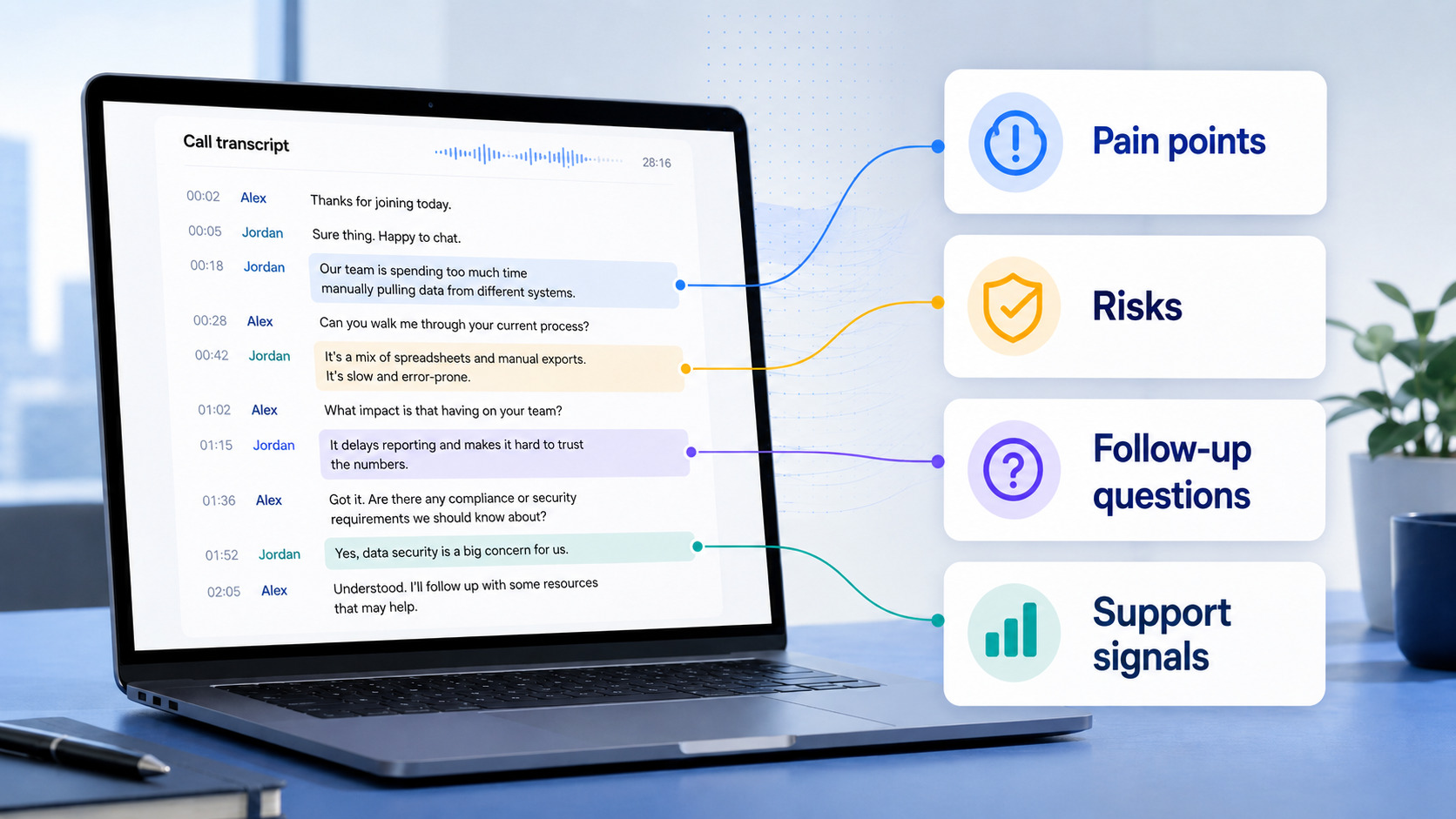
Not long ago, the Sales Engineer’s toolkit looked a lot like it did in the late 1990s: a deep product knowledge base, a well-rehearsed demo, a legal pad full of discovery notes, and a sixth sense for when a prospect was genuinely interested versus politely running out the clock. Mastery took years. Pattern recognition was a private art, living inside the heads of the best SEs and largely dying with their departure.
That era is ending. Not because the human skills have become less valuable — if anything, they matter more — but because AI has arrived as a serious co-pilot, one that can process what we can’t hold in working memory and surface what we might otherwise miss.
From gut feel to grounded insight
The traditional SE discovery process produced a lot of signal and a lot of noise in roughly equal measure. A 60-minute qualification call might contain three critical technical requirements, two red flags about integration complexity, and one offhand comment from the CTO that changes everything — buried inside 57 minutes of polite preamble. Catching all of it, in the moment, while also managing your demo environment, answering questions, and reading the room? That’s an enormous cognitive load.
AI-powered analysis of call transcripts changes the dynamic entirely. When a recording and its transcript are reviewed in an approved, well-prompted AI workspace, patterns emerge quickly: recurring objections, technical constraints that were mentioned but not fully explored, capability gaps that map to open support tickets, and moments of genuine enthusiasm that can reveal deal momentum not always obvious from CRM fields alone.
“The transcript doesn’t forget. It doesn’t have a bad day, and it doesn’t get distracted by the next question before it’s finished processing the last answer.”
The result isn’t just faster prep — it’s a fundamentally higher floor for technical qualification. Junior SEs operating with AI-assisted analysis can develop stronger pattern recognition faster. Senior SEs, freed from the cognitive overhead of note synthesis, can go deeper on the nuances that actually close deals.
Three inputs, one coherent picture
The real leverage comes not from any single data source but from triangulating across three that most SE teams already collect:
| Call Transcripts | Customer Interviews | Support History |
|---|---|---|
| Surface objections, technical requirements, and emotional signals buried in conversation. | Reveal the gap between stated needs and actual workflows — often where the real risk lives. | Show which product areas generate friction and inform honest capability conversations. |
When AI synthesizes these three streams together, something powerful happens: the subjective (“I think they care about security”) becomes grounded (“Security was raised in three separate contexts, two of which correlated with delayed decisions in similar past deals”). Shortcomings that might have been downplayed in a discovery call become visible because the support queue tells a different story. And strengths that the prospect hasn’t asked about yet can be proactively surfaced before a competitor does.
For example, after an initial qualification call, an SE can use an approved AI workspace to review the transcript and identify the customer’s stated pain points, open technical risks, and areas that need deeper validation. That output can become the basis for a more focused demo talk track: not a generic feature tour, but a demo that addresses the issues the customer actually raised. As the deal progresses, the same material can help the SE draft a technical validation document that maps the customer’s applications, workflows, constraints, and follow-up questions. By the time the opportunity moves toward implementation, those notes can also become a cleaner handoff for the deployment team.
The art of the deeper question
Perhaps the most underappreciated application of AI in SE work is question generation. Discovery is only as good as the questions asked, and the questions asked are only as good as the understanding behind them. Most SE teams develop a standard discovery framework and iterate on it slowly over years. AI can compress that iteration dramatically.
By analyzing transcripts alongside a product’s capability map, an AI tool can help identify gaps where qualification is weak — the areas where a prospect said something technically imprecise that the SE let slide, where an assumption was made that wasn’t validated, or where a use case was described that has an unacknowledged dependency the product handles differently than expected.
From there, the tool can generate follow-up questions that are genuinely probing: not the generic “what does your current workflow look like?” variety, but the “you mentioned your team processes claims from three different payer systems — can you walk me through how those reconcile today?” variety. The kind of question that signals expertise, builds trust, and often unlocks the most important information in the entire deal cycle.
“AI doesn’t replace the SE’s judgment — it gives that judgment better raw material to work with. The question still has to land right. The room still has to be read.”
Identifying what’s working — and what isn’t
There’s a less glamorous but equally important application: retrospective analysis. Most SE teams have a rough sense of what differentiates their wins from their losses, but the data behind that sense is rarely rigorous. Anecdote dominates. Recency bias shapes best practices. The deal that closed last quarter looms larger than the fifty before it.
AI-assisted analysis of historical transcripts and deal records can produce a more structured view: a pattern map of what technical conversations, demo sequences, and qualification approaches appear to correlate with positive outcomes — and which ones don’t, regardless of how good they feel in the moment. A particular feature demo that the team loves might consistently land flat with a specific buyer persona. A technical objection that SEs typically handle one way might have a better resolution that emerged organically in a few winning deals and never got codified.
Making that institutional knowledge explicit, searchable, and trainable is one of the most durable advantages AI offers SE organizations.
That leverage also needs guardrails. Call transcripts, customer interviews, support history, and technical validation notes may contain confidential business information. SE teams should use company-approved AI tools, follow recording and consent policies, redact sensitive customer details when appropriate, review AI outputs before using them with customers or implementation teams, and avoid placing customer data into unmanaged or personal AI accounts. The productivity gain only matters if it does not create new risk for customer data.
What doesn’t change
It would be a mistake to read any of this as a diminishment of the SE role. The opposite is true. As AI handles more of the synthesis and pattern-matching work, what’s left — the relationship building, the technical credibility established in the room, the judgment call about when to push and when to listen, the creative problem-solving for edge-case requirements — is purely human territory, and it’s where deals are actually won.
The SEs who will thrive in the next decade are those who adopt AI as a genuine thinking partner: using transcript analysis to walk into every call better prepared, using support data to have honest capability conversations before they become late-stage surprises, and using AI-generated question frameworks as a starting point they then make their own.
The playbook isn’t being replaced. It’s being written faster, updated more often, and shared more widely than ever before.


Want more Sales Engineering content?
Get the best NAASE thinking each month: new articles, sharp perspectives, and exclusive insights.
Join NAASE