One Deal, Six Countries: How AE/SE Teams Win Across Markets
by Marco Lembo
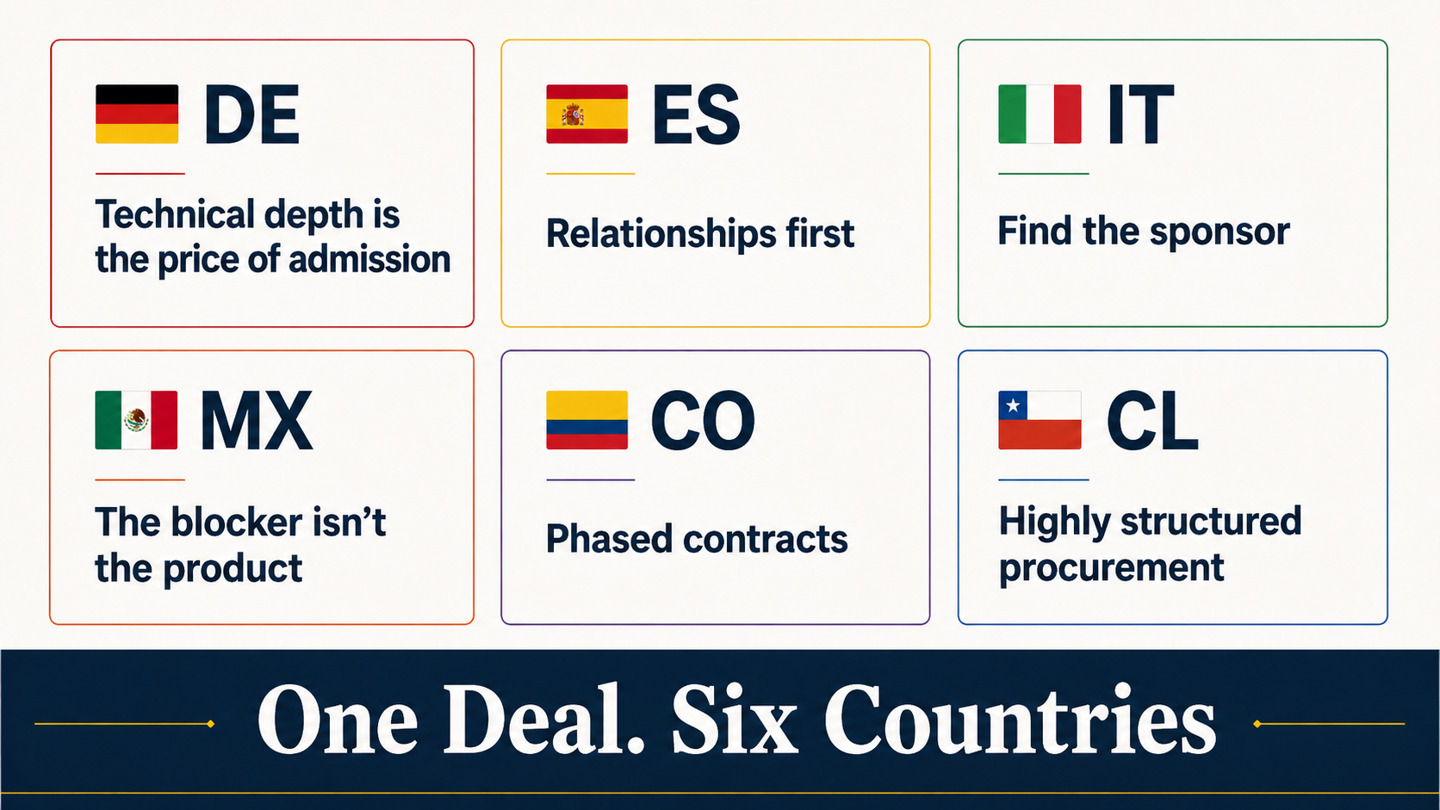
EMEA isn’t a market. LATAM isn’t a market. They’re budget line items that make CFOs feel global and sales teams feel overwhelmed.
Every country in those acronyms has its own buying culture, its own risk calculus, and its own unwritten rules for how decisions actually get made. The AE and the SE who walk into that room without a shared playbook aren’t running a multi-market deal — they’re running one deal badly, in several languages.
These are field patterns, not universal rules. Sector, deal size, company maturity, and individual stakeholders can override national tendencies. The point is not to stereotype a market, but to help AE/SE teams test the right assumptions early.
The first session: two people, two tracks, one room
Most SE/AE teams treat the first technical session as a product showcase. It’s not. It’s the most information-dense 60 minutes in the entire deal cycle — if both people know what they’re looking for.
- The SE’s job: map the technical estate. Stack, integrations, legacy debt, data silos. Identify which use cases have real infrastructure behind them and which are aspirational. Surface technical limitations before they become late-stage blockers.
- The AE’s job: read the room. Who asks follow-up questions? Who checks their phone? Who books the next meeting before this one ends? Buying temperature isn’t in the CRM — it’s in the body language of a buying committee spread across three countries.
A prospect who books a technical workshop within 48 hours of the first session? That’s pipeline with legs. One who declines? Qualification failed upstream. The SE surfaces it technically; the AE has to own what that means commercially.
Risk discovery: what buyers actually evaluate
Hardly anyone on a multi-country buying committee is asking “does this solve our data problem?” They’re asking “if this goes wrong, is my job at risk?”
There are three risk dimensions in every enterprise deal, and the SE and AE own one side of each:
-
Vendor stability
SE: Integration depth, data portability, lock-in exposure.
AE: In-market references, financial backing, roadmap visibility.
-
Internal adoption risk
SE: Who in IT will block this, and why.
AE: Who in the business will sponsor it, and what they need to tell the CFO.
-
Champion career risk
SE: Is the technical champion senior enough to defend the architecture decision?
AE: Is the commercial champion senior enough to survive a procurement committee challenge?
The handoff between the SE’s technical read and the AE’s commercial reframe is where deals accelerate — or quietly die.
The country checklist: same product, different room
The value story doesn’t change. What changes is what earns credibility, who makes the decision, and what “yes” actually means.
 Germany
SE: Send the architecture diagram before the meeting. They’ve already read it. Twice. Technical depth is not optional — it’s the price of admission.
AE: ROI needs to be documented, not pitched. Bring the spreadsheet, not the story. Consensus is real; if you haven’t aligned procurement, legal, and IT before the final call, you haven’t aligned anyone.
 Spain
Spain
SE: Technical credibility follows personal trust, not the other way around. A brilliant demo to someone who doesn’t know you yet lands at about 40% power.
AE: The decision was made at lunch. You weren’t there. Local references from Madrid or Barcelona outperform any global logo. Find out who knows who before the first meeting.
 Italy
Italy
SE: Hierarchy is real — present to the right seniority or the technical validation doesn’t stick. A nod from a junior architect means nothing if the CTO hasn’t been briefed.
AE: Everyone agreed in the room. Ask again in two weeks. Executive sponsorship must precede committee movement — a champion without a sponsor is just an enthusiast.
 Mexico
SE: U.S. proximity creates false technical familiarity. Integration assumptions that hold in a U.S. enterprise stack don’t always translate — validate early, don’t assume.
AE: The real blocker is the internal politics between IT and el negocio, not your product. Map both sides of that divide before you build your champion strategy.
 Colombia
SE: Risk-averse buyers want to see proof of concept before committing to architecture decisions. Budget a POC into the plan, not just the pipeline.
AE: Phased commercial structures unlock deals that full-contract approaches stall. Local references from Bogotá outperform anything regional — the market is growing fast but trust radius is still local.
 Chile
Chile
SE: Arguably the most structured procurement in the region, and often closest to European buying behavior. Compliance posture and security documentation need to be ready, not reactive.
AE: Don’t mistake the professionalism for speed. Procurement is thorough, not fast. Documented ROI and vendor stability signals land well — this is a market where the spreadsheet wins.
The one ritual that changes everything
Before every multi-country touchpoint — demo, workshop, exec presentation — run a 20-minute AE/SE sync. One question drives it:
“What did we learn last session that we haven’t addressed yet?”
Buying committees shift. Champions go quiet. New stakeholders appear with new agendas. The SE who surfaces a technical blocker in week six is only useful if the AE can reframe it commercially before it becomes a dead end. That only happens if both sides are talking.
Multi-market enterprise deals don’t fail on product.
They fail on coordination.


Want more Sales Engineering content?
Get the best NAASE thinking each month: new articles, sharp perspectives, and exclusive insights.
Join NAASE