The SE’s Guide to Uncomfortable Questions
by Max Lüpertz

In Sales Engineering, many people, myself included, tend to be a bit too agreeable. And to be fair, that’s usually a good thing. It means you want to build trust, create a positive dynamic, and work well with the people around you.
But it can also lead to a very specific problem. In discovery calls, demos, or POCs, we often ask questions in a way that makes it very easy for the customer to say “yes.” We avoid friction and instead choose the path of least resistance.
Ask for the “no”
But in my view, it’s incredibly important to occasionally ask for a “no.” Not because you want to create tension, but because you want to surface concerns while you still have the chance to work through them together.
That’s where I think many people get it wrong. They treat objections as something negative, something to avoid, almost like a conflict with the customer. But that’s not how I see it.
An objection is not something you need to win. It’s simply something you need to solve, together. That doesn’t mean pushing your opinion onto the customer or proving them wrong. It just means acknowledging your customer’s concern and helping both sides arrive at a solution.
Why surfacing concerns early matters
And that’s exactly why it’s so important to bring objections to the surface early. If you don’t, they usually don’t disappear. They just stay hidden.
They sit quietly in the background and only show up later, often at the worst possible moment: when the customer is close to signing and suddenly starts having second thoughts. That’s usually when doubts creep in.
- Is this really the right decision?
- Will implementation be harder than expected?
- Will the team actually use it?
- Will someone internally push back?
And at that stage, you often have very little control. Because now the customer is sitting alone at their desk, thinking things through, and you’re no longer in the room to help shape the conversation.
Ask uncomfortable questions
That’s why I believe it’s so important to ask what I’d call uncomfortable questions, such as:
- I understand this project is important to you, but how do your colleagues see it?
- Does anything here feel too risky to adopt?
- Is there anyone internally who might be skeptical?
- If your boss says no, what would their concern be?
- If we don’t solve this now, what happens?
- What’s the hardest part about adopting this in your team?
These are not aggressive questions. They are useful ones.
And yes, sometimes they lead to a “no.” Sometimes the customer pauses and says, “Actually, there are a few risks.” That’s a good thing. Because now you can talk about them, build a plan, and address them while you still have influence.
Know what your customers are already reading
This becomes even more important when you consider how buyers actually buy today. Most of them won’t just rely on your demo. They’ll do their own research. They’ll read reviews and check what other customers are saying on platforms like G2, Capterra, or OMR Reviews.
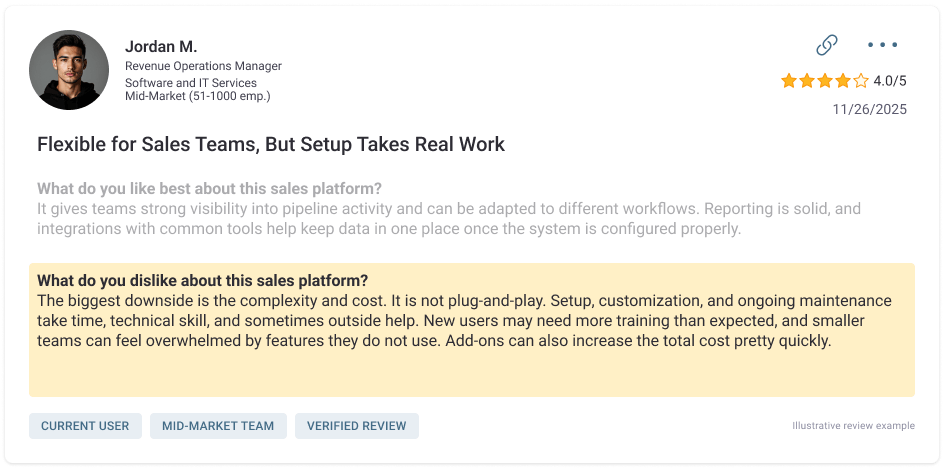
Your future customers are often reading the same concerns that your existing customers have already written down publicly, such as:
- Implementation took longer than expected
- Onboarding was harder than expected
- The product required more training than anticipated
That information is already out there. So instead of hoping your customer hasn’t seen it, it’s often smarter to bring it up yourself. Ask them directly:
“Out of curiosity, have you seen any reviews about us? Was there anything in there you had questions about?”
That one question alone can surface concerns that would otherwise stay hidden until much later. And that, to me, is one of the most overlooked parts of good Sales Engineering: not just helping the customer see the value. But helping them talk openly about what might stop them from moving forward.
A simple piece of homework
Go to one of the major review platforms and look up your own product. Focus on the negative reviews (maybe that’s my inner German talking, but I’m far more interested in the three-star ones than the five-star ones. That’s usually where the truth is).
Write down the top three concerns that come up most often. Because chances are, your future customers are reading exactly the same things. And if they are, you should be ready to talk about them, preferably before they become a problem. Then bring it into your next customer call: “Out of curiosity, did you check any reviews? Any questions about what you read?“
A note on culture
This is also very much a cultural topic. Some cultures are far more direct when it comes to expressing doubt, disagreement, or negative feedback, while others will do their absolute best to stay polite, sound interested, and avoid saying “no” too openly, even when they are not truly convinced. That makes it even more important not to mistake politeness for buying intent.
If you want to go deeper on this, I can highly recommend the book The Culture Map by Erin Meyer. It’s one of the best resources I know for understanding how differently people communicate across cultures.


Want more Sales Engineering content?
Get the best NAASE thinking each month: new articles, sharp perspectives, and exclusive insights.
Join NAASE