How to use discovery to build a demo the buyer actually needs to see
by Natasja Bax
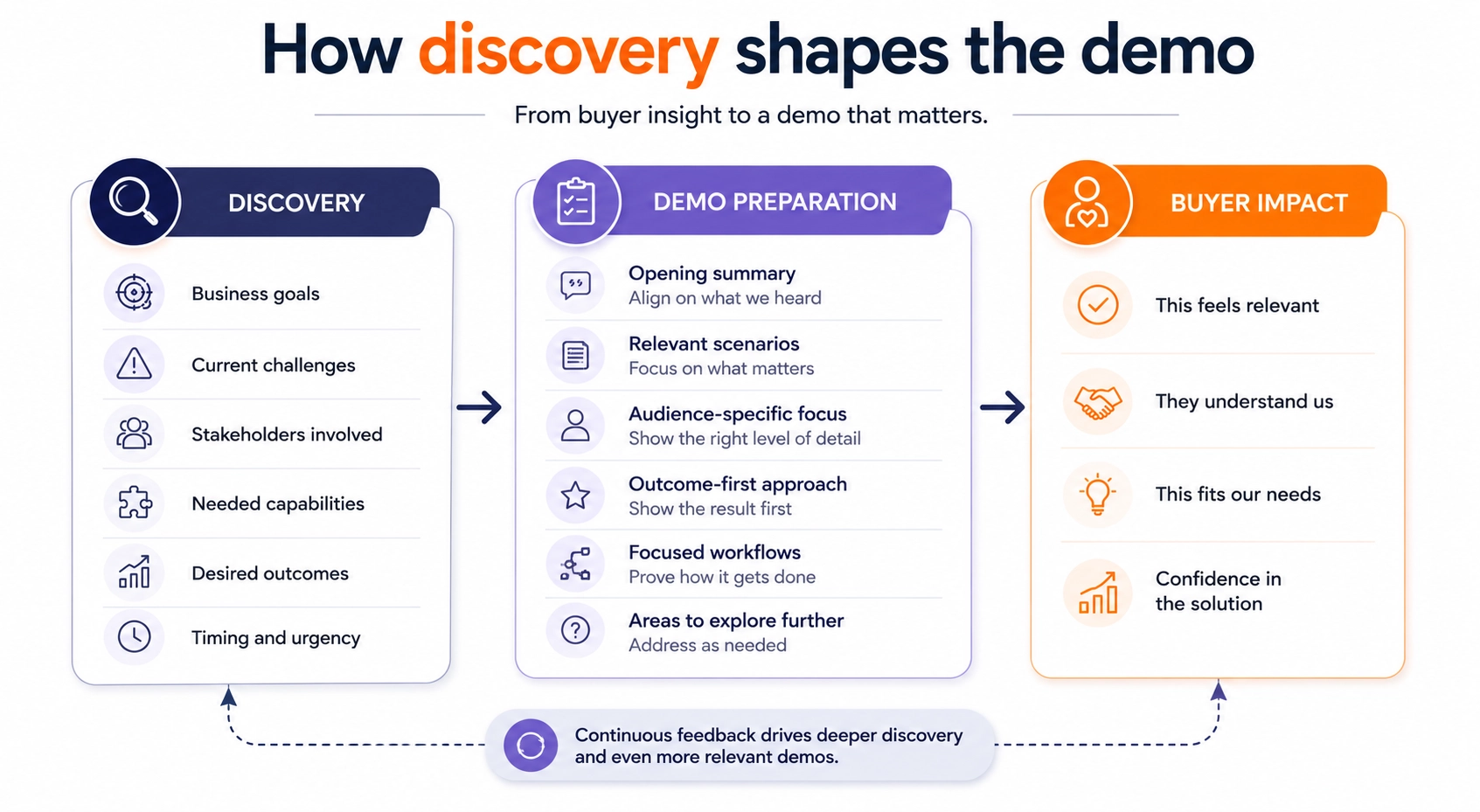
Most presales teams treat discovery as a preparatory step. They ask questions related to the demo system setup, document what the buyer mentions on the surface, and then build a demo that covers everything that might be relevant. The result often is a product tour. The buyer sits through features they did not ask for, workflows they do not need, and capabilities they will never use, and somewhere in the last fifteen minutes, they finally see the thing they came to see.
I have watched this happen hundreds of times across twenty years of working with software sales teams in Europe. And in most cases, the issue started long before the demo began.
Discovery done well is not a research exercise. It is a filtering mechanism. Every answer the buyer gives you is a signal about what belongs in the demo and what does not. The teams that understand this build demos that feel inevitable. The buyer leaves thinking this was built for us specifically. That is what you are working toward.
When discovery is still unfolding
A quick caveat: not every demo starts with complete discovery. Sometimes the buyer is still exploring what they need. In those situations, the goal is not yet to prove fit. The goal is to open a vision of what becomes possible using industry knowledge, patterns, and success stories rather than the buyer’s exact situation.
In this article, we focus on demos that follow a strong discovery conversation. The steps below apply when discovery has progressed far enough that the objective is to prove your solution solves a specific, understood problem.
Prepare for the people in the room
Before you build your demo map, consider who will be in the room and what each person needs to see. Discovery tells you who the stakeholders are and how the demo should speak to each of them.
An executive needs dashboards, trends, and business impact. A manager needs monitoring, exception handling, and team coordination. A team member needs daily workflow, speed, and simplicity. Showing the wrong level of detail to the wrong audience is one of the most common reasons technically strong demos fail to move deals forward, and it is almost always a preparation failure rather than a delivery failure.
Start with a clear summary of what you heard
Before you prepare your demo system, write down what the buyer told you and turn it into a simple customer summary. Include their role, their most important business challenge, the problems making it difficult to solve, the specific capabilities they need, what improvement would mean to their business, and the timeline driving urgency.
This becomes the foundation for every decision that follows. If a capability does not connect to something in that summary, it probably does not belong in the demo.
The best customer summaries are written in the buyer’s own words. Start your demo with a summary of what they told you. This lets them know you listened and care, and it provides context for the demo. When you present it back at the start of the demo, they should hear their own language reflected with precision.
“You shared that your goal is to reduce unplanned downtime. The main challenge is that your team is working from delayed manual reports, and what you need is real-time visibility so you can respond before an asset fails rather than after. Is that still accurate?”
That moment of recognition shifts the conversation from vendor presentation to genuine dialogue.
Convert what you heard into demo chunks
Take the capabilities the buyer described and organize them into self-contained scenarios, each mapping directly to something they told you they needed.
A VP of Support Operations who said they need automated escalation, unified customer history, and SLA monitoring gets three demo chunks built around exactly those three things.
What was not discovered generally does not belong here, even if it is impressive. The instinct of Solution Consultants is to show more rather than less, to demonstrate breadth, to cover everything that might land. But a focused twenty-minute demo tied directly to what the buyer described is almost always more persuasive than a ninety-minute walkthrough.
A broad demo often feels generic. A focused one feels like it was built for the buyer.
Show the outcome before you show the process
Great Demo! refers to this as “Do the Last Thing First.” Instead of building toward the payoff, you begin with it.
For each chunk, start with the result rather than the process that produces it. Open with the live dashboard, the completed workflow, and the alert that catches the issue before it becomes a problem.
“What you are seeing here is immediate visibility into which accounts are at risk, with recommended escalations already prioritized for your team, helping managers respond earlier and reduce missed renewals.”
Then ask: “Is this what you had in mind?” to confirm you are moving in the right direction before going deeper.
Then, and only then, show how the product produces that result using the fewest clicks and the simplest path possible.
The buyer has already seen the outcome. Now they need to believe they can get there.
Go deeper only when the buyer asks
After proving the outcome, stop and give the buyer space to respond. If they want to understand how something is configured, how permissions work, or how the integration connects to their existing systems, they will ask.
And when they do, that question tells you what they want to explore further and where their attention is. If they do not ask, move to the next chunk.
The buyer’s curiosity should drive depth, not your agenda.
Use discovery to decide what not to show
For every capability you are considering including, ask three questions:
- Which specific thing the buyer described does this support?
- Which stakeholder asked for it?
- Which business outcome does it prove?
If you cannot answer clearly, cut it.
The strongest demos usually show less, not more. Every additional screen beyond what is needed to prove the buyer can achieve their desired outcome creates another opportunity to introduce confusion, irrelevance, or doubt.
The mindset that makes this work
Some solution consultants ask the wrong questions when preparing a demo. They ask questions so they know how to set up the demo system.
The question that produces better demos is this:
What is the minimum evidence this buyer needs to believe they can achieve the outcome they described? What’s the main problem we need to solve?
That shift changes everything about how the demo is built, what is included, what is cut, and how the buyer experiences the conversation.
The difference discovery makes
The teams that make this shift show up to customer conversations knowing exactly what they are there to prove and why it matters to this specific buyer. The demos become shorter, the questions become more specific, and the deals move faster, not because the product changed, but because the preparation did.
Buyers notice the difference.
You can feel it in how the conversation changes when you open with a summary that sounds like you were genuinely listening rather than preparing a pitch. You can feel it when a buyer says, “Yes, that is exactly our situation,” before you have shown them a single screen.
A demo without discovery is a product tour. A demo built on real discovery is a mirror. And when a buyer sees their own situation reflected back with precision, they are much closer to a decision than they were before the demo began.


Want more Sales Engineering content?
Get the best NAASE thinking each month: new articles, sharp perspectives, and exclusive insights.
Join NAASE