From RFPs to RFIs: What a Shift in Government Buying Signals Means for Sales Engineers
by Marc Benton
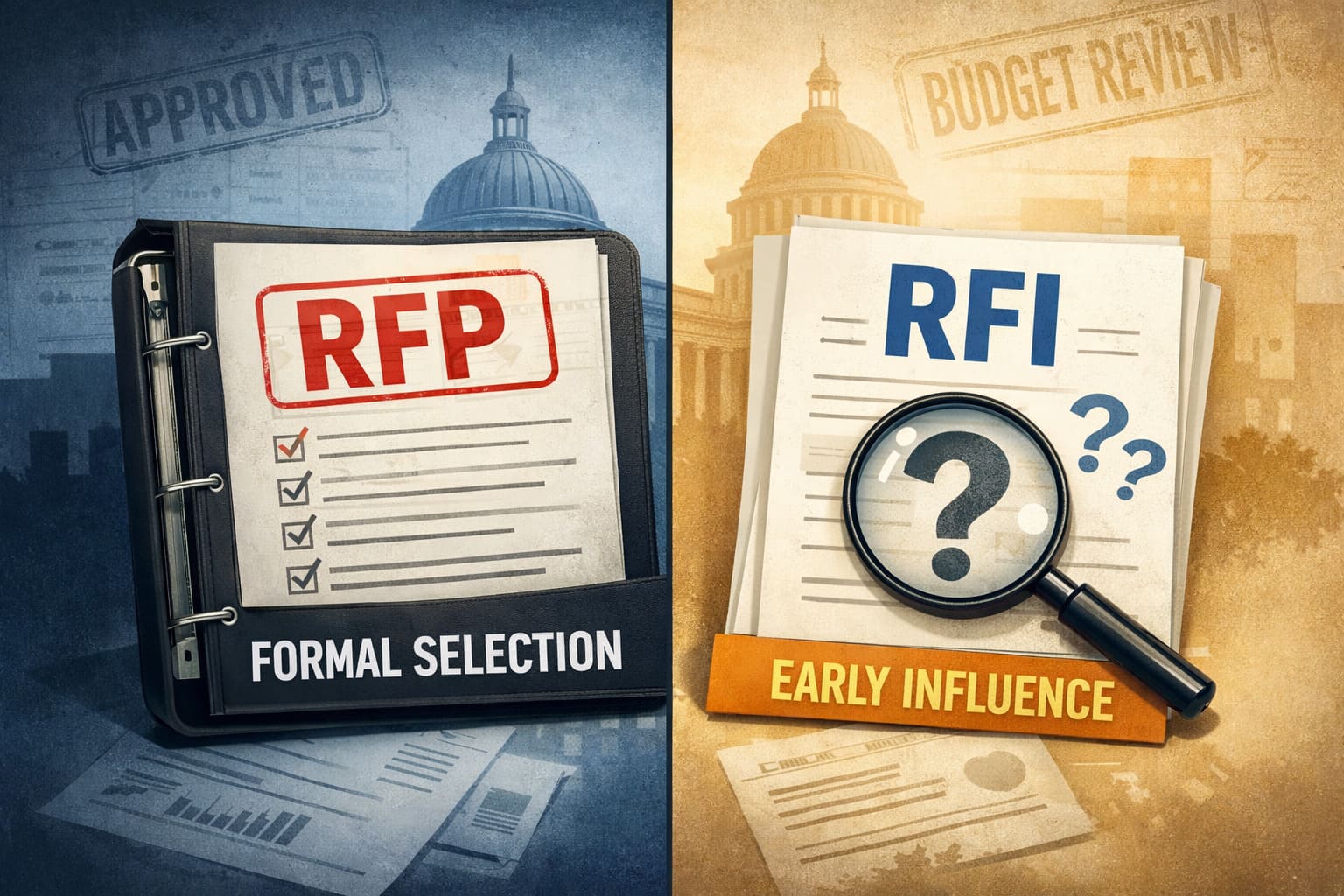
Over the past year, I’ve noticed a subtle but consistent change in how government organizations approach the search for a new learning management system. Formal Requests for Proposals (RFPs) are appearing less frequently, while Requests for Information (RFIs) are becoming more common.
This shift isn’t dramatic enough to make headlines, but it’s meaningful. And for sales engineers working in the public sector, it carries important implications. RFIs signal a different stage of buyer intent, a different set of constraints, and a different role for sales engineering than the RFPs many teams are more accustomed to supporting.
Understanding what this change represents—and responding accordingly—can make the difference between wasted effort and long-term influence.
Why the Shift? Understanding What’s Driving RFIs Over RFPs
The increase in RFIs—and corresponding decline in formal RFPs—does not appear to be accidental. In many cases, it reflects broader forces shaping how government agencies are being asked to plan, justify, and sequence technology investments.
One clear driver has been the current administration’s emphasis on cost reviews and fiscal discipline across federal agencies. This year, agencies have faced heightened scrutiny around discretionary spending, with leadership teams required to demonstrate clear value, alignment to mission outcomes, and cost efficiency before advancing formal procurements. In that environment, RFIs provide a useful mechanism to gather information without signaling financial commitment.
Compounding this has been budgetary uncertainty tied to government funding disruptions, including the federal government shutdown earlier in October and the possibility of additional shutdowns or continuing resolution cycles. These events introduce real operational risk: procurements can be paused mid-process, funding authority can shift, and internal priorities can change with little notice. RFIs allow agencies to continue market research and planning even when formal contracting activity may be temporarily constrained.
Related to this is the growing influence of DOGE-led and DOGE-aligned efforts to identify cost savings and operational efficiencies across agencies. These initiatives often encourage agencies to reassess existing tools, consolidate platforms, or delay new commitments until clearer savings or efficiencies can be demonstrated. RFIs support this approach by enabling agencies to understand pricing models, capability overlap, and alternative architectures without committing to a procurement timeline.
There is also a practical procurement consideration at play. Issuing an RFP requires confidence in requirements, scope, and funding. When agencies are still reconciling internal priorities, awaiting budget clarity, or responding to external cost controls, formalizing those requirements can feel premature. RFIs reduce procurement risk by allowing agencies to test assumptions and refine thinking without locking themselves into language that may later need revision.
Finally, the increasing complexity of enterprise platforms compounds this behavior. Security mandates, cloud hosting models, compliance frameworks, and integration expectations introduce questions that many agencies need help answering before they can credibly draft an RFP. RFIs serve as a structured way to educate stakeholders and build shared understanding across IT, procurement, finance, and program leadership.
Taken together, these factors suggest that many RFIs are not failed RFPs—they are deliberate pauses. They signal interest and intent to learn, but not yet authority to buy.
What This Means for Sales Engineers
For sales engineers, this trend requires a shift in mindset.
RFIs typically sit much earlier in the buying cycle than RFPs. Treating them with the same compliance-heavy approach can lead to misaligned effort and missed opportunities. The goal of an RFI response is rarely selection; it is understanding.
This places sales engineers in a more consultative role. Instead of simply demonstrating that a solution can meet a defined set of requirements, SEs are often helping buyers clarify what those requirements should be in the first place.
That role comes with challenges. RFIs can be time-consuming, ambiguous, and difficult to qualify. There is real risk in over-engineering responses, making premature commitments, or investing heavily without a clear path forward.
At the same time, RFIs reward judgment. Knowing what to answer directly, what to frame at a high level, and what questions to reflect back to the buyer is often more valuable than providing exhaustive technical detail.
How Sales Engineers Should Respond to a Government RFI
Responding effectively to RFIs requires a different approach than traditional RFP responses.
Clarity matters more than completeness. RFIs are an opportunity to explain patterns, common approaches, and trade-offs rather than to prescribe fully customized solutions. Overly detailed or speculative responses can create confusion rather than confidence.
Strong RFI responses focus on:
- Use cases rather than feature checklists
- Proven approaches rather than hypothetical configurations
- Boundaries and assumptions rather than guarantees
They also acknowledge uncertainty where it exists. Being transparent about dependencies—organizational readiness, data quality, integration scope—helps buyers understand the real work involved and builds trust.
Perhaps most importantly, RFIs should open doors, not close them. A good response invites dialogue, encourages follow-up questions, and positions the sales engineer as a resource rather than a respondent.
A strong RFI response leaves the buyer smarter, not overwhelmed.
Redefining What It Means to “Win” an RFI
One of the most common mistakes teams make is evaluating RFIs by the same criteria as RFPs.
Winning an RFI does not mean being selected. More often, it means shaping the conversation that follows. It means helping influence how requirements are written, how risks are framed, and how success is defined if and when a formal procurement begins.
Success at the RFI stage shows up in subtler ways:
- Requests for clarification or deeper discussion
- Invitations to brief additional stakeholders
- Evidence that your language or concepts appear in later documents
These are indicators of influence, not closure.
Adapting Without Becoming Cynical
The increase in RFIs and decline in RFPs can be frustrating, especially for teams measured on efficiency and near-term outcomes. But this shift is not inherently negative. It reflects caution, complexity, and a buying environment in transition.
For sales engineers, it reinforces the importance of engaging earlier, thinking more strategically, and resisting the urge to treat every document as a transactional exercise.
When RFPs disappear, sales engineering does not become less important. It becomes more important—earlier in the process, when understanding is still being formed, and decisions are still fluid.
That is where experienced sales engineers can provide the greatest value.


Want more Sales Engineering content?
Get the best NAASE thinking each month: new articles, sharp perspectives, and exclusive insights.
Join NAASE