

How Sales Engineers Turn Expertise into Repeatable Impact
A practical model for turning recurring SE expertise into reusable systems, measurable impact, and more capacity for complex work
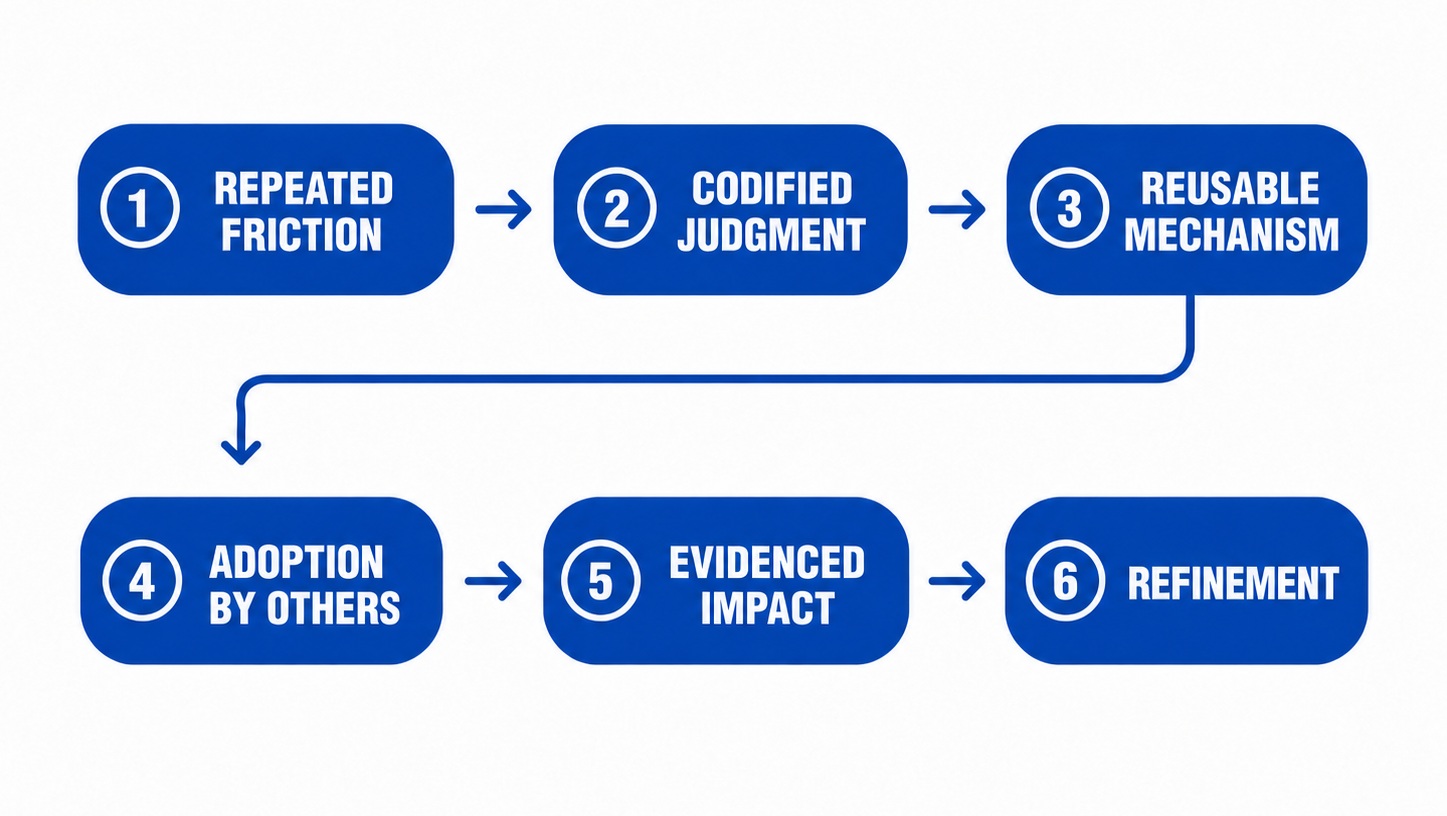
Sales Engineering expertise is often most visible in the moment: the right discovery question, a sharper demo narrative, a risk caught before it becomes a failed evaluation, or a technical explanation that helps a buyer move forward. But when that value depends on one person being present every time, expertise becomes difficult to scale and exhausting to sustain.
This article introduces the Sales Engineer Leverage Lifecycle, a practical model for turning recurring, experience-based judgment into something others can use without stripping away the context and human judgment that made it effective:
Repeated friction → codified judgment → reusable mechanism → adoption by others → evidenced impact → refinement
The key distinction is easy to miss. Creating a playbook, video, workflow, or knowledge base is an output. It becomes leverage when someone else can use it. It becomes proven leverage when that use improves speed, quality, consistency, decisions, or customer outcomes.
The lifecycle helps SEs and leaders identify recurring dependencies, capture the reasoning behind good decisions, choose the smallest useful form, design for real adoption, measure what changed, and improve the mechanism through use. These sales engineer best practices put expertise to better use: less repetitive rebuilding, stronger teams, clearer evidence of SE impact, and more time for the complex customer moments that still require an expert in the room.
The problem: When expertise becomes a bottleneck
Think about the best Sales Engineer on your team. Which difficult demo gets handed to them? Which POC needs their attention? Who gets called when a prospect asks the question nobody else can answer?
That expertise did not appear overnight. It was built through repetition: asking better discovery questions, learning which proof points matter to each stakeholder, recognizing where evaluations tend to stall, and knowing when a customer needs deeper technical detail or a clearer business outcome.
All of that is far more than product knowledge. It is technical understanding combined with customer context, commercial awareness, experience, and timing. That is what makes a strong SE so valuable.
But here is the problem. The same objections return. Similar demos are rebuilt. New hires ask questions someone has already answered. Before long, one SE becomes the only person trusted with every difficult POC, executive conversation, or field issue.
It may look like exceptional performance, and often it is. But it is also a capacity warning.
The goal is not to remove the expert from complex work. It is to stop requiring that expert to recreate the same value every time. Save their judgment for the moments that truly need it, and make the repeatable part available to everyone else.
The model: Sales Engineer Leverage Lifecycle
1. Repeated friction
Most leverage opportunities begin with something annoying: the same problem showing up again.
Maybe an AE asks the same question. A demo needs the same customization. Buyers get confused at the same point. A POC loses time during setup. New hires depend on one experienced SE. A field team keeps running into a familiar problem. Does that sound familiar?
The issue is not difficulty. Sales Engineers handle difficult work every day. The signal is repetition.
Before building an asset or process, decide whether this is a one-time request or a recurring pattern. One customer may need a custom answer. When it appears across customers, regions, or team members, it may deserve a reusable solution.
Diagnostic question: What have you explained, rebuilt, rescued, or answered more than twice?
2. Codified judgment
Let’s be clear: saving work is not the same as capturing judgment.
A deck shows what you presented. A demo recording shows one performance. A folder keeps files together. Useful? Yes. But do they explain why the SE chose that story, skipped a feature, challenged a requirement, or changed direction?
That is what codification captures: the signals noticed, the information that mattered, the tradeoffs considered, and the moments when the standard approach no longer applied.
This is difficult because experienced SEs make these decisions almost instinctively. What feels obvious to the expert may be invisible to everyone else.
Decision rules, discovery prompts, qualification criteria, escalation points, narrative structures, evaluation checkpoints, and examples of strong and weak responses can make hidden reasoning reusable.
Diagnostic question: What decision are you making that another person would not know how to make?
3. Reusable mechanism
Now that the judgment is visible, how do you make it useful when the original SE is not in the room?
Give it a form people can actually use. That could be a playbook, short video, demo framework, onboarding wizard, checklist, SOP, reference architecture, shared knowledge hub, customer roadmap, or teaching routine. The format itself is not the point. What matters is whether the right person can apply the right judgment at the right moment.
And bigger is not always better. A two-page guide used every week creates more leverage than a beautiful portal nobody can navigate. A short buyer explanation may do more than a full recorded demo. A guided workflow may beat a folder full of instructions.
But leave room for context. Reuse should make good decisions easier, not pretend every customer, account, or industry is the same.
Diagnostic question: What is the smallest reusable form that preserves the judgment that matters?
4. Adoption by others
You created the mechanism. Great. But is anyone actually using it?
That is the difference between an asset and leverage. Another SE, AE, new hire, customer champion, partner, product team, or field operator must be able to find it, trust it, know when it applies, and use it without lowering the quality of the work.
This is where many smart internal projects fall apart. The content is accurate, but buried. The process works, but lives outside the normal workflow. The tool promises to save time, but takes longer to set up than the task itself. The playbook gets shared once, with no training, owner, or follow-up.
So be specific. “The team” is not a user. “An AE preparing for first discovery in a new segment” is. When you know exactly who needs the mechanism and when they need it, you can design for real adoption.
Diagnostic question: Who will use this, when will they need it, and what could stop them?
5. Evidenced impact
So people are using the mechanism. Great. But is it actually making anything better?
Leverage needs proof connected to the friction you started with. If POC setup was too slow, measure cycle time. If demos were inconsistent, look at preparation time, conversion, buyer progression, or quality. If tribal knowledge was the problem, examine ramp time, repeated interruptions, rework, or dependence on one expert. If the issue was field efficiency, use the operational measures that matter there.
Now, the evidence does not have to be perfect. SE influence is spread across people, decisions, and stages of the sales cycle. But downloads, page views, and file counts only show activity. They do not show value.
The strongest evidence connects adoption to an outcome: who used the mechanism, how often they used it, and what improved afterward.
Diagnostic question: What result would convince you that this improved the work instead of simply adding another resource?
6. Refinement
Your mechanism is working. People are using it. Are you done? Not quite.
Real use will expose assumptions you missed, context you did not include, steps nobody needs, and opportunities you could not see in version one.
Refinement does not need to be complicated. Update an SOP after a product change. Shorten a video when buyers lose interest. Add an exception to a qualification rule. Improve an onboarding workflow. Bring field feedback into the next release.
This is how reuse starts to compound. The mechanism improves, and the organization gets smarter about the original problem.
It may also reveal the next bottleneck. A faster demo process can expose weak qualification. Better POC setup can uncover unclear success criteria. Improved onboarding may show that the underlying knowledge needs to be reorganized.
Refinement can begin before broad adoption and continue after it. Teams often tune a mechanism before teaching it, then improve it again as real use exposes gaps.
Diagnostic question: What did real use teach you that the first version could not?
From output to leverage
Let’s be honest: creating more content does not automatically create more leverage.
A video, playbook, or knowledge base may look impressive, but what happens if nobody uses it? Then you have output, not impact.
Output: You created something.
Leverage: Someone else used it.
Proven leverage: That use improved speed, quality, consistency, decisions, or customer outcomes.
The goal is not to build the biggest library. It is to reduce a real dependency without losing the judgment that made the original work valuable. Maybe an AE handles an early conversation more confidently. Maybe another SE prepares faster. Maybe a champion explains value internally without you in the room.
But be careful. Scripts can replace listening, automation can speed up a bad process, and documentation can become stale. Reuse the repeatable part. Protect the expertise that still needs a human.
The lifecycle in practice
Enough theory. What does this lifecycle look like when experienced Sales Engineers put it to work? The answer takes several forms.
Internal knowledge and onboarding. One seasoned SE leader saw the same questions returning while important know-how remained trapped in people’s heads. She turned that tribal knowledge into a shared engineering resource with templates, demo materials, SOPs, and a more consistent process across regions. New hires no longer had to start from zero, and the resource kept improving as the team used it.
Demos and evaluations. A senior solutions engineer recognized that product-heavy demos were not always helping buyers make decisions. She developed a repeatable narrative, workshops, reusable materials, AE playbooks, and self-service demos. The result? POC build time reportedly dropped from roughly twelve weeks to three.
Cross-functional enablement. A global SE leader faced a different problem: demos, POCs, and technical evaluations were flowing through one person. He converted field experience into a toolkit that sales, product, marketing, and customer success could all use. Reported results included demo-time reductions of up to 50 percent and a 25 percent increase in early-stage conversions.
Buyer communication outside the meeting. One technical sales engineer focused on an uncomfortable reality: some of the most important buying conversations happen when the SE is not there. He created stakeholder-specific videos addressing objections, value, features, and outcomes. Over nine months, those videos were sent hundreds of times and were associated with faster deal movement, stronger qualification, and mid-seven-figure revenue influence.
Guided operational workflows. Another experienced SE turned a repeated onboarding process into a guided, automated workflow. Work that once required hours was reduced to minutes, while newer team members gained a clearer path to follow. He extended the same principle beyond his company by sharing practical knowledge with the broader SE community.
Different mechanisms. Different audiences. Different business environments. But the pattern is remarkably consistent: valuable SE judgment moved out of one person’s head and into something other people could actually use.
How NAASE developed this model
NAASE reviewed transcripts from eight videos recorded by the SE2025 finalists. Each transcript was assessed for six elements: repeated friction, codified judgment, a reusable mechanism, adoption by others, evidenced impact, and refinement.
Five cases aligned strongly with the lifecycle. Three reflected related forms of leverage but did not contain clear evidence for every stage. None presented evidence that directly contradicted the model.
This is a qualitative practitioner analysis, not a statistical study or industry benchmark. The eight SEs had been selected through the SE2025 award process, which evaluated impact, innovation, and leadership or community contribution. Their examples were self-reported and were not independently verified. The award criteria also favored measurable outcomes, repeatable approaches, adoption, mentoring, and documented results.
NAASE compared the transcript findings with existing material on knowledge transfer, presales enablement, buyer enablement, and related technical roles. The lifecycle represents the synthesis that best accounted for the strongest recurring pattern in the source material.
Scope and applicability
The lifecycle applies most directly when recurring SE work can be translated into a reusable mechanism. It does not describe every form of SE impact.
Some expertise scales through curiosity, research, and the ability to find the right answer across product, engineering, and customer contexts. This can improve decisions and customer experience without producing a distinct asset or process.
Some impact is relational. Long-term technical partnership, customer trust, and coordinated execution can improve adoption and expand an account over time. One example described an OEM relationship that grew from partial product use to full portfolio adoption and later expanded into another market.
Other expertise is field-based. Operational knowledge may be transferred through roadmaps, mentoring, observation, and team practice. One example associated this approach with reducing intermediate work from more than 47 hours to approximately 12 to 18 hours.
These examples define the model’s scope. The lifecycle describes one set of sales engineer best practices for creating leverage, not every form of Sales Engineering excellence.
Bottom line
So what does leverage really mean? It gives Sales Engineers more time for the situations that genuinely require their expertise, instead of repeatedly recreating the same value.
When an SE turns recurring friction into clear judgment, a reusable mechanism, real adoption, measurable impact, and continuous improvement, their experience starts helping far more people.
That is how individual expertise becomes repeatable impact.
Contributors

Enterprise Specialist, Smart Trailers, Samsara

Sale Engineer, NOV-ReedHyclaog

Sales Engineer, Samsung Electronics America

Solutions Engineering Manager, Ontra

Director of Sales Engineering and Business Development, Charlotte Pipe and Foundry Company Infrastructure

Solutions Engineer, Eagle Eye

Senior Sales Engineer, Automation Anywhere

Implementation Project Coordinator, Corpay